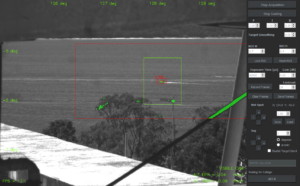
A screenshot of a prior laser communications test as viewed through the in-house Pointing, Acquisition and Tracking Software UI. Credit: Ayden McCann UWA
Naval vessels must often maintain strict radio silence to avoid revealing their position or being intercepted by an adversary. Laser communications address this directly: a narrow optical beam carries data at high bandwidth with an inherently low probability of detection or intercept, giving naval vessels a tactical communications edge without broadcasting their position. ICRAR Astrophotonics is developing this technology for ship-to-ship and ship-to-shore links, with testing planned aboard an Austal Evolved Cape Class patrol boat.
The core engineering challenge is keeping the laser on target. Ships roll, pitch, and yaw as they move through waves, and even small angular movements can push the beam off course.
This project aims to build a platform motion simulator in Python using publicly available vessel motion datasets, producing realistic roll, pitch, and yaw time series that drive a hardware-in-the-loop tracking testbed. This allows the pointing and tracking control system to be tested under realistic sea conditions in the lab, without needing to be at sea. The simulator output is also intended to combine GPS positions and target coordinates to compute the full three-dimensional pointing demand on the laser terminal.
The student will build real software that feeds directly into an active research program. You will source and process publicly available vessel motion data, develop a Python-based motion simulator, and deliver a tool the broader team will use to drive hardware-in-the-loop testing of the laser tracking system.
If ship availability permits, there is scope to validate and extend the simulator using real data collected from the Austal Evolved Cape Class patrol boat.
No prior experience with lasers or defence systems is needed, just strong Python skills and an interest in applied engineering with real-world impact
| Student attributes | |
| Academic background | Physics, Engineering, or Mathematics |
| Computing skills | Proficiency in Python. Familiarity with NumPy/SciPy
desirable. |
| Training requirement | N/A |
| Project timeline | |
| Week 1 | Inductions and project introduction |
| Week 2 | Initial presentation |
| Week 3 | Literature review: ship motion dynamics and hardware in-the-loop simulation techniques. Source and process publicly available vessel motion datasets. |
| Weeks 4-6 | Implement parametric motion simulator in Python; generate synthetic roll/pitch/yaw time series across a range of sea states. |
| Weeks 7-8 | Refinement, edge-case testing, and documentation of simulator as a reusable Python module. |
| Week 9 | Final presentation |
| Week 10 | Final report |