The Astronomical Society of Australia (ASA) has recognised Dr Ziteng (Andy) Wang from the Curtin University node of ICRAR with the 2026 Louise Webster Prize at this year’s Annual Scientific Meeting.
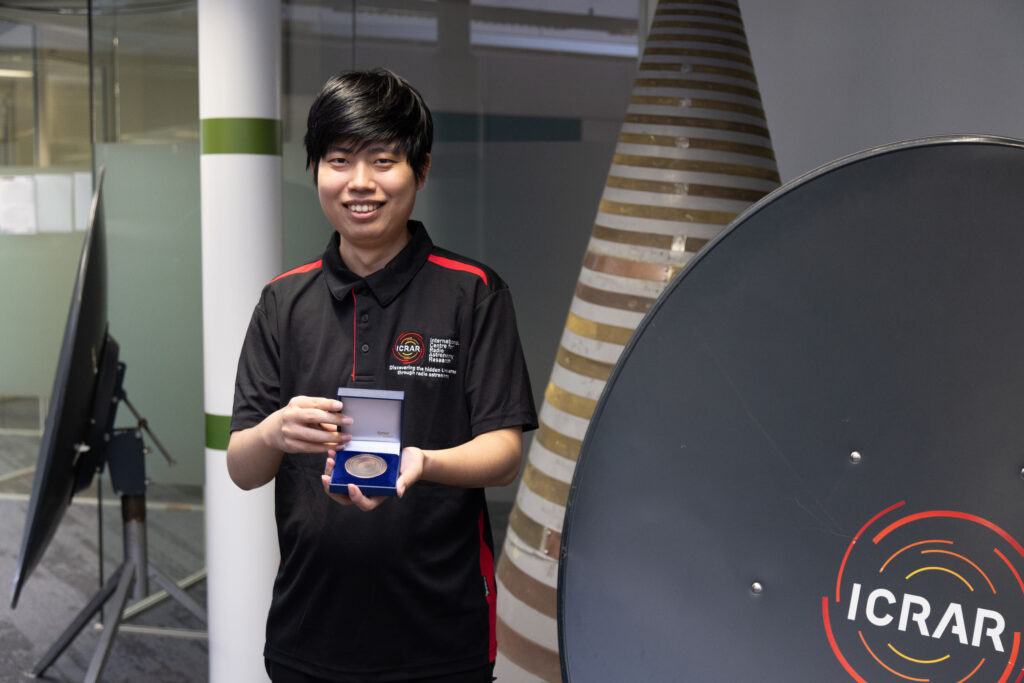
Dr Ziteng Wang, with the 2026 Louise Webster Prize medal, at the Curtin University node of ICRAR. Credit: ICRAR
The Louise Webster Prize is awarded for Outstanding Research by a Scientist Early in their Post-Doctoral Career. The 2026 prize was jointly awarded to Dr Takafumi Tsukui (ANU, now Kavli IPMU, Japan) and Dr Wang for his 2025 discovery of a Long Period Transient (LPT) visible in X-rays as well as radio waves.
Long-period radio transients are a recently discovered and deeply mysterious class of objects that pulse with radio waves on timescales of minutes to hours — far slower than any known pulsar. What generates these pulses, and what kind of object is at their heart, is one of astronomy’s newest and most compelling puzzles.
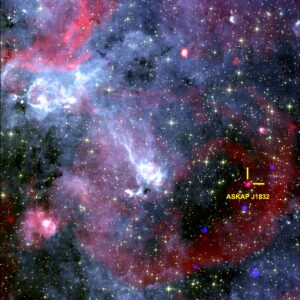
An image of the sky showing the region around ASKAP J1832-0911. X-rays from NASA’s Chandra X-ray Observatory, radio data from the South African MeerKAT radio telescope, and infrared data from NASA’s Spitzer Space Telescope. Credit: Ziteng Wang. ICRAR
Dr Wang’s discovery was the first such detection since the discovery of LPTs by ICRAR researchers in 2021, and represents a major step forward in determining what long-period radio transients actually are.
The discovery took advantage of a rare coincidence, as CSIRO’s ASKAP radio telescope, on Wajarri Yamaji Country in Western Australia, and NASA’s Chandra X-ray telescope, in orbit around the Earth, happened to be observing the same patch of sky at the same time.
“It was already exciting to be published in Nature, and it is great that this work has been recognized as important by the Australian astronomy community,” said Dr Wang.
Still based at the Curtin University node of ICRAR, Dr Wang is continuing to search the skies for LPTs, building on the techiques developed in his 2025 paper.
“What I’m doing now is trying to find more of them, trying to build a larger population to understand them in detail,” he said.
“We’re using the same telescope, but also we are trying to have new techniques to discover more.”
Read more about the ASA awards at Science In Public.