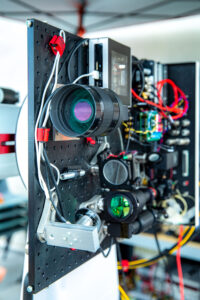
Caption: Optical system Credit: ICRAR Astrophotonics
Applying quantum measurement techniques to astronomy will allow us to build telescopes with resolution surpassing any existing telescope. In this project, you will work alongside researchers working to build the world’s first practical quantum telescope.
The exact project will be tailored to the student’s skills and interests. Possible work includes, but is not limited to:
- Assisting with or conducting experiments testing and proving the performance of quantum imaging systems in the laboratory (mostly comprising optics and optomechanics, some electronics and/or programming),
- Programming control systems for the small telescopes used in on-sky experiments at UWA,
- Applying machine learning techniques to read-out and interpret complex data coming from the imaging system,
- Assisting with the maths and algorithms of image reconstruction to turn telescope data into images,
- Modelling quantum telescope performance to determine the engineering requirements and general design of a future observatory, or
- Exploring relevant quantum information theory to determine quantum-optimal ways to scale up quantum imaging from the laboratory to real-world telescopes.
This project will suit students with interest in any of a range of fields including astronomy, quantum physics, optical physics, theoretical physics, mechanical/mechantronics/electrical engineering, and programming. The student will work with the supervisor to determine the exact project goal and timeline based on the student’s interests, providing an opportunity for students to apply their existing skills, broaden their skill set, and get experience in cutting-edge research.
| Student attributes | |
| Academic background | Physics, engineering |
| Computing skills | Programming proficiency (Python or similar) is useful, but not essential. |
| Training requirement | None |
| Project timeline | |
| Week 1 | Inductions and project introduction |
| Week 2 | Initial presentation |
| Week 3 | Construct experiment |
| Week 4 | Collect data |
| Week 5 | Analyse data |
| Week 6 | Modify experiment |
| Week 7 | Collect data |
| Week 8 | Analyse data |
| Week 9 | Final presentation |
| Week 10 | Final report |