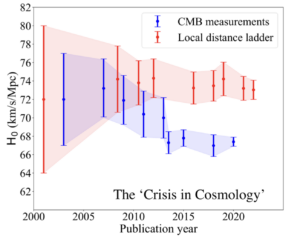
The plot above shows the growing tension between measurements of the Hubble constant, H0, from two different methods: Cosmic Microwave Background (CMB) measurements and the local distance ladder. This project will develop a code for an independent measure of the Hubble constant from a unique method of watching the redshift of different sources change in real time.
As the Universe expands, the velocity at which galaxies move away from us changes. At the most distant redshifts it actually increases. It was realised in the 1960’s that this change in velocity (known as redshift drift) could potentially be measured over 1000’s of years from a single emission line. However, the transformational SKA has the ability to measure this velocity shift over a few decades by repeatedly observing the 21-cm forest in bright radio galaxies in the early Universe. The large number of absorption features permit more stringent constraints on the measurement of this shift. This project will develop simulations of the 21-cm spectrum as measured by the SKA of different sources and different cadences over the five decades of expected SKA operation. The outcome will be a prediction of the minimum parameters to measure this shift to sufficient precision to constrain the Hubble constant to 1% or better. The outcome of this project will help motivate early SKA observations of the 21-cm forrest.
| Student attributes | |
| Academic background | physics, astrophysics or computing (although some understanding of cosmology and statistical computing analysis) |
| Computing skills | Familiarity and willinesses to improve knowledge of Python or a similar code if already competent. |
| Training requirement | n/a |
| Project timeline | |
| Week 1 | Inductions and project introduction |
| Week 2 | Initial presentation |
| Week 3 | Develop code to take noiseless simulations and predict SKA observations. |
| Week 4 | Develop code to take noiseless simulations and predict SKA observations. |
| Week 5 | Produce a suite of synthetic observations of different targets at differing times |
| Week 6 | Produce power spectra to measure the change in redshift. |
| Week 7 | Repeat simulations N times to obtain an estimate of uncertainties. |
| Week 8 | Use the measured redshift to constrain the Hubble constant |
| Week 9 | Final presentation |
| Week 10 | Final report |