Congratulations to our 2025 award recipients, Dylan Grigg from ICRAR-Curtin and Ayden McCann from ICRAR-UWA.
The Ken & Julie Michael Prizes are made possible by a generous donation from former chair of the ICRAR Board, Dr Ken Michael AC, and recognise the outstanding achievements of our graduate students at both ICRAR-Curtin and ICRAR-UWA.
Professor Simon Ellingsen presented this year’s prizes at the November Board meeting, which was also attended by the WA Minister of Science’s representative, Hon Dr Parwinder Kaur MLC, the WA Chief Scientist Professor Sharath Sriram, Student supervisors, the ICRAR Executive, and the ICRAR Board.
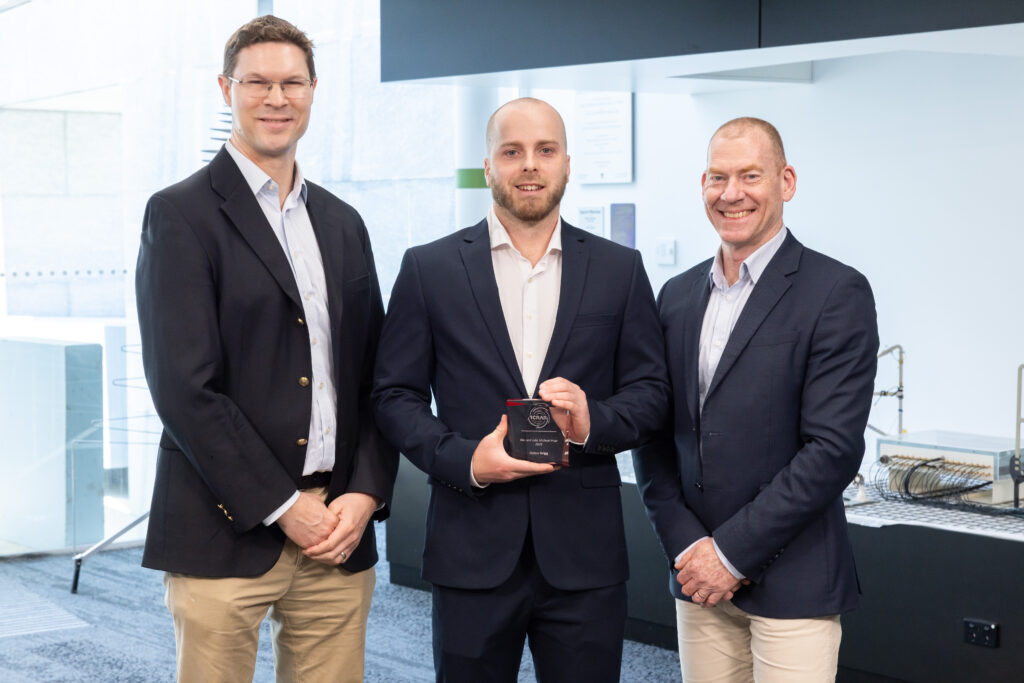
ICRAR-Curtin award recipient Dylan Grigg, with his supervisors Professor James Miller-Jones and Professor Steven Tingay.
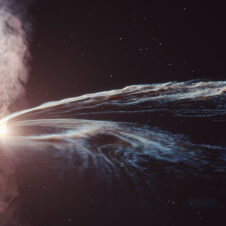
Dylan Grigg (ICRAR-Curtin) has advanced the field of space domain awareness through the development and execution of pioneering large-scale analyses of unintended satellite emissions at low radio frequencies, providing key insights into the upcoming challenges to be faced by SKA-Low. His research papers have received significant attention from both academia and media, demonstrating that there is a global concern about the influence of uncontrolled satellite emissions on our ability to conduct radio astronomy from the surface of the Earth. Dylan has exhibited strong communication skills by effectively presenting complex research results to diverse audiences in astronomy, physics, engineering, and policy making.
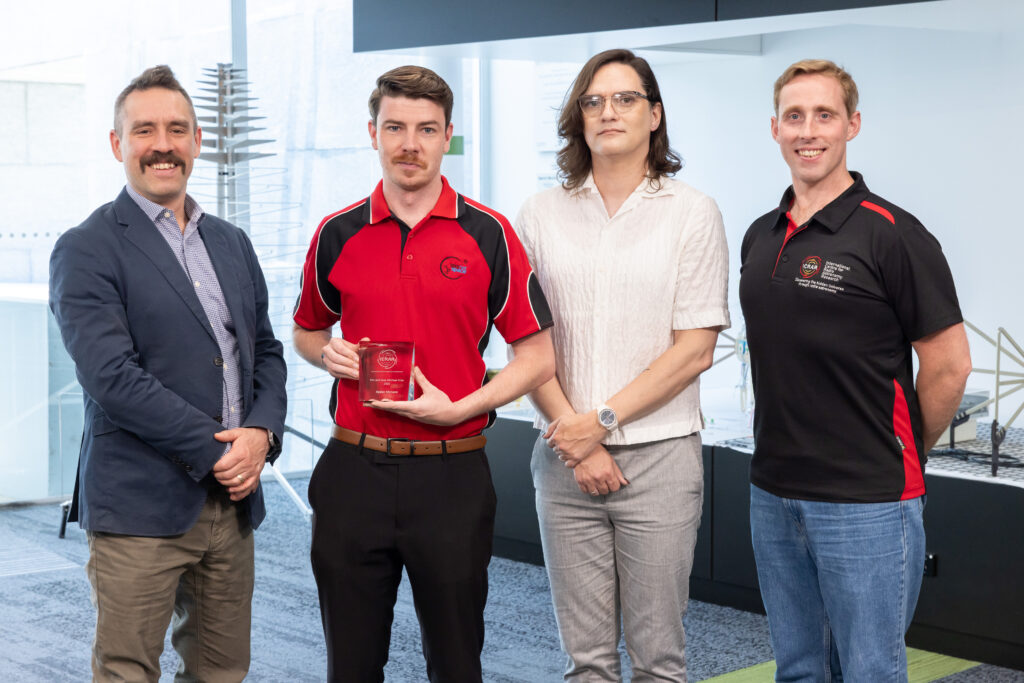
ICRAR-UWA recipient Ayden McCann, with his supervisors Professor Sascha Schediwy, Dr Lyra Walsh, and Dr David Gozzard.
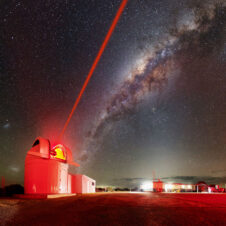
Ayden McCann (ICRAR-UWA) has revolutionised free-space optical communications by developing the world’s first daylight-deployable Transportable Optical Ground Station, enabling rapid, reliable satellite communications in diverse environments including disaster zones and contested military areas. His innovative Pointing, Acquisition, and Tracking system has significantly enhanced the versatility, accessibility, and scalability of optical ground stations. His efforts have led to Australia’s first optical satellite downlinks, securing IP disclosures that are now undergoing commercialisation, and have also attracted interest from defence and venture capital sectors. Ayden’s work truly is contributing to the future of high-speed, secure laser communications across land, sea, air, and space.
ICRAR congratulates the winners and their supervisors, as well as all the applicants for their achievements. We would also like to extend our deepest thanks and gratitude to Dr Ken Michael for his generous and ongoing support for this Prize since it began in 2017.
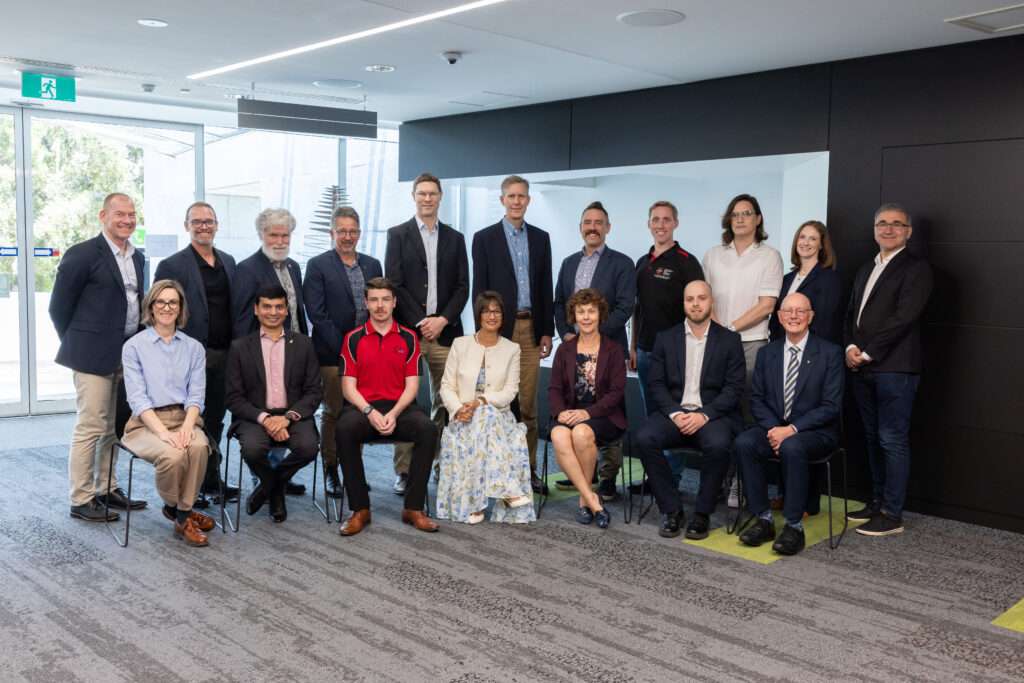
The 2025 Ken & Julie Michael Prize winners with Hon Dr Parwinder Kaur LMC (front-centre), WA Chief Scientist Professor Sharath Sriram (front-left) and supervisors, members of the ICRAR board and executive.
Previous recipients include Chenoa Tremblay & Tristan Reynolds (2017), Ahmed Elagali & Sam McSweeney (2018), Mengyao Xue & Fei Qin (2019), Dr Pikky Atri, Dr Kate Harborne & Benjamin Dix-Matthews (2020), Stefan Duchesne, James Buchan & Ruby Wright (2021), Torrance Hodgson, Jishnu Thekkeppattu, Jessica Thorne & Mitchell Cavanagh (2022), Angelica Waszewski, Skevos Karpathakis & Jennifer Hardwick (2023), and Tyrone O’Doherty & Andrei Ristea (2024).