Investigating the nature of long-period transients, a newly discovered class of radio transients, can widen our knowledge on how plasmas and magnetic fields interact in extreme environments.
An international team observed a long-period transient non stop for 2 days in a study published in Nature Astronomy.
Over the past four years, a new class of signals from the Universe has captured astronomers’ attention. These events originate from galactic objects known as long-period transients (LPTs), whose nature remains unknown. They appear as repeating bright radio pulses with unusually long periods. So far, around 12 such sources have been discovered, but their origin and the mechanisms that generate their emission are still unclear. A new study published in Nature Astronomy, led by ICRAR PhD student Csanad Horvath, investigates the longest-lived LPT known.
GPM J1839-10 is the name of the longest-known LPT, with a 21- min period, observed in the Milky Way. It has now been demonstrated to be a binary system hosting a white dwarf. This system consists of a spinning white dwarf (a stellar remnant) and a red dwarf (a star smaller than the Sun). It adds scientific evidence to two previous studies that proposed other LPTs as the same type of binary systems, showing that most LPTs may share a similar origin. The exact physics behind the bright radio pulses of these sources has now been related with the interaction between the white dwarf pulsar magnetic field and the wind of the companion star.

Artistic impression of the red dwarf and white dwarf interaction of the long-period transient GPM J1839-10. Credits: D. Futselaar/Horvath, Rea, Hurley-Walker et al. 2026
“This work demonstrates a novel way of shedding light on the nature of LPTs, a field that started only 3 years ago and has been revealed to be key to understanding the radio transient sky”, says Nanda Rea, from the Institute of Space Sciences (ICE-CSIC) and the Institute of Space Studies of Catalonia (IEEC), co-author of the study.
These findings may represent the first steps toward understanding the true nature of all LPTs and, consequently, revising our knowledge of white dwarf and red dwarf binaries. “Radio emission produced by white dwarf binaries might be more prevalent and diverse than previously thought,” suggests Rea.
To carry out the study, the international team, composed of six researchers from astronomy research institutes in Australia and Spain, conducted a continuous 40-hour observation of GPM J1839−10. This required three radio telescopes operating sequentially at different locations around the world: the MeerKAT telescope in South Africa, CSIRO’s ASKAP radio telescope on Wajarri Yamaji Country in Australia, and the Karl G. Jansky Very Large Array (VLA) in the United States of America. “Each telescope handed the source to the next as the Earth rotated to keep the source in view,” explains Csanad Horvath, a PhD student at the Curtin University node of ICRAR, who led the work and spent a month at ICE-CSIC to finalize the analysis.
This allowed the team to record the signal pattern with high precision for subsequent analysis. They discovered that the radio pulses arrive in groups of 4 or 5 and that they come in pairs separated by two hours. A pattern that repeats every 9 hours, suggesting orbital motion with such period happens within the source system.
Using a theoretical model based on the same geometric framework proposed for white dwarf pulsars, the team accurately reproduced the intermittent emission and double-pulse structure. This strongly supports the interpretation that the LPT is a white dwarf–red dwarf binary system, and allowed to measure the system characteristics as the orbit, the inclination in our line of sight and star masses. In this scenario, radio pulses are produced whenever the magnetic axis of the spinning white dwarf, the imaginary line connecting its two magnetic poles, intersects the stellar wind of its companion, generating a bright radio signal. In every orbit the bright radio pulses can be seen twice, with 4-5 pulses every time.
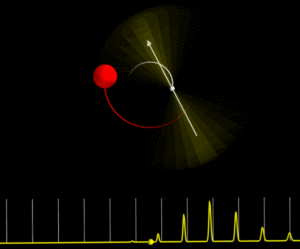
The white and red spheres are the white dwarf and M-dwarf. The arrow represents the white dwarf’s rotating magnetic moment. The yellow cone is the radio beam whose brightness depends on the alignment of the white dwarf’s magnetic moment with the M-dwarf. Below is the radio flux density detected on Earth. Animation from interactive by Csanad Horvath.
Beyond revealing the likely nature of one known LPT, the study also provides a framework to investigate many more such objects. The model applied to the growing population of LPTs and other known white dwarf binary pulsars have shown the connection between these apparently different classes as well as shed light on the evolution of magnetic properties of white dwarf and red dwarf binaries.
Publication
Horváth, Rea, Hurley-Walker, McSweeney, Perley, & Lenc (2026), ‘A binary model of long-period radio transients and white dwarf pulsars‘, Nature Astronomy. DOI: 10.1038/s41550-025-02760-y.
Adapted from a media release by Institute of Space Studies of Catalonia (IEEC)