A major international astronomy project led from Western Australia is moving into its next phase, bringing researchers closer to understanding how galaxies formed, how the Universe is structured and the role of dark matter in shaping it.
The Wide Area VISTA Extragalactic Survey (WAVES), co-led by researchers at The University of Western Australia’s node of the International Centre for Radio Astronomy Research (ICRAR-UWA), is one of the largest scientific programs using the new Four-Metre Multi-Object Spectroscopic Telescope (4MOST).
After 15 years of preparation and collaboration among research teams worldwide, the start of 4MOST operations marks the beginning of five years of observations for WAVES.
The survey will gather measurements for millions of galaxies, providing researchers with new evidence to investigate the evolution of the Universe.
Led by Professor Simon Driver, WAVES Principal Investigator at ICRAR-UWA, and The University of Hamburg it will examine how galaxies and larger cosmic structures have changed over approximately seven billion years of cosmic history.
It aims to improve our understanding of dark matter – an invisible form of matter whose gravitational influence plays a fundamental role in the formation and organisation of galaxies.
“It is incredibly exciting to see WAVES move from planning and development into data collection,” Professor Driver said.
“Wherever we search, we find a vast region that we cannot detect at any wavelength, and we call it dark matter.
“The imprint of dark matter can be felt across the Universe, shaping everything we see.
“Different theoretical models of dark matter predict subtly different imprints on the structure of the Universe and this what we aim to measure.”
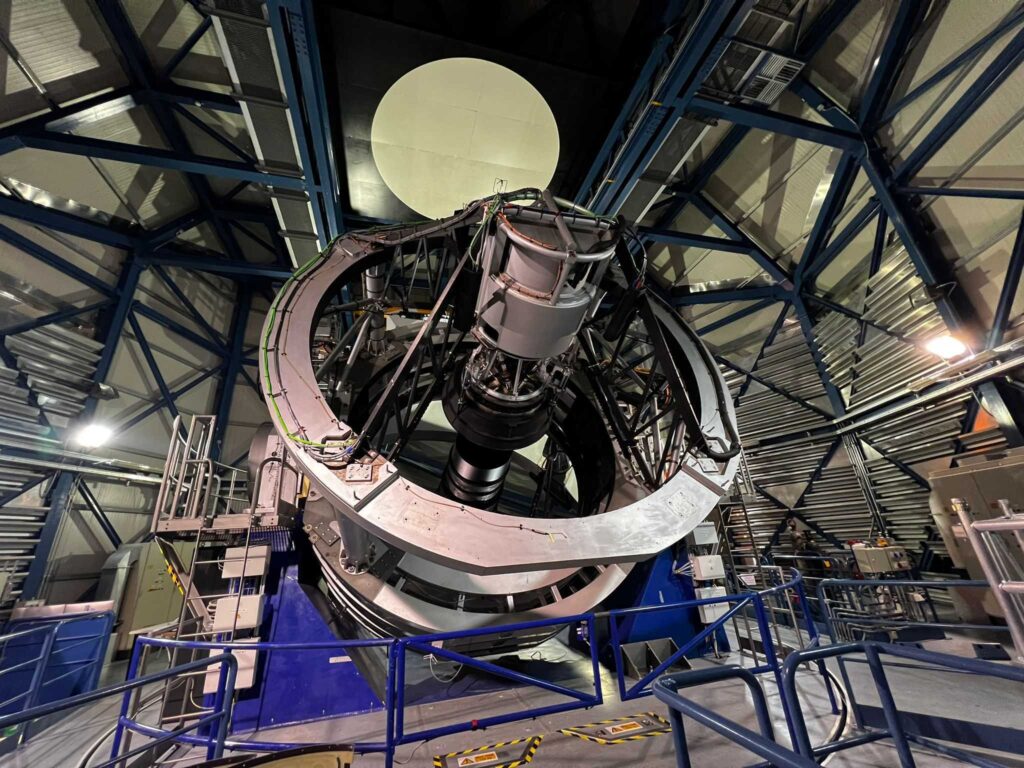
Caption: 4MOST (the 4-metre Multi-Object Spectroscopic Telescope) at the European Southern Observatory.
Credit: Ajay Dev
Located at the European Southern Observatory’s Paranal Observatory in Chile, 4MOST is a next-generation facility that can collect light from thousands of astronomical objects simultaneously.
By measuring the distances, movements, and properties of galaxies across an enormous volume of space, WAVES will map the cosmic web formed by galaxy groups, clusters, and vast empty regions.
The measurement will help researchers investigate how matter is distributed and how dark matter’s gravitational influence has shaped the Universe over roughly seven billion years of cosmic history.
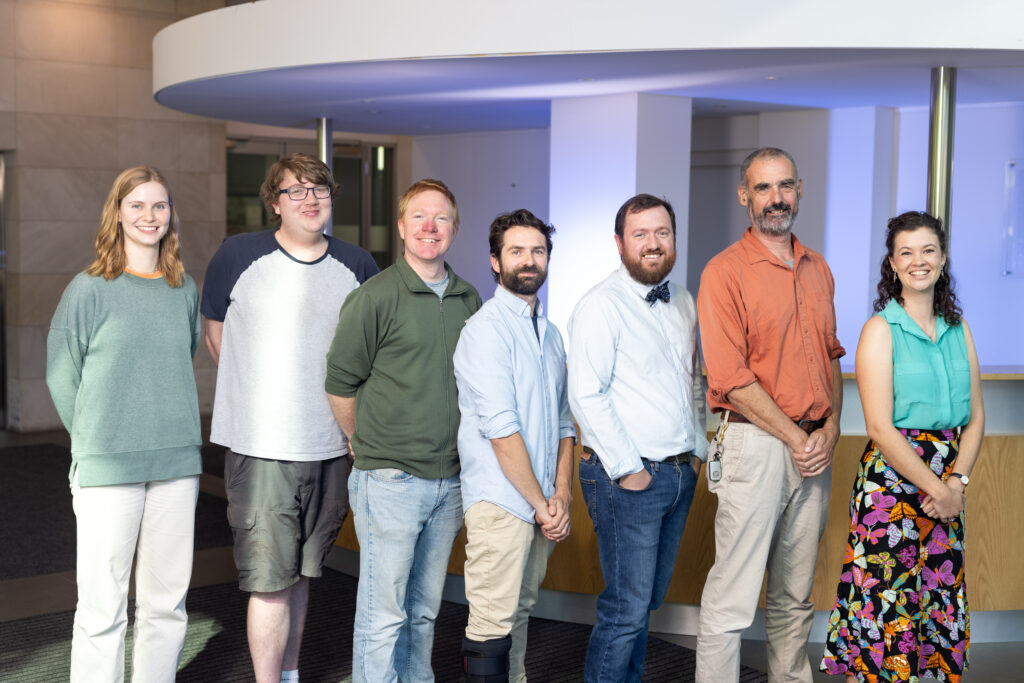
WAVES team members from ICRAR-UWA (L-R: Dr Dior Etherton, Dr Adam Marshall, Prof. Aaron Robotham, a/Prof Luke Davies, Dr Trystan Lambert, Prof. Simon Driver, Dr Sabine Bellstedt). Credit: ICRAR
Dr Sabine Bellstedt, WAVES Program Scientist at ICRAR-UWA, said the survey’s scale and depth would open new possibilities for astronomical research.
“Until now, observations of the structure of the Universe have been too low resolution to identify some of the subtle differences predicted by competing dark matter models but this will all change with WAVES,” Dr Bellstedt said.
“We are mapping many more galaxies across a much larger volume of the Universe than ever before, allowing us to build an increasingly detailed picture of the cosmos.
“It’s like taking a map of Australia that is currently a blurry rectangle and accurately mapping out all the coves, beaches and estuaries.”
Researchers and technical specialists at UWA have played a critical role in preparing the survey for WAVES’ operations, developing the scientific, data-processing and software capabilities needed to make a project of this scale possible.
The team processed a large amount of existing astronomical imaging, identified potential galaxy targets, distinguished stars from galaxies and developed highly accurate catalogues and photometric distance estimates – work essential to ensure 4MOST can efficiently identify and observe the right astronomical objects.
ICRAR-UWA has also led the development of critical software to process the volume of data the telescope generates.
Associate Professor Luke Davies co-led the development of the pipeline designed to extract approximately 25 million distance measurements in real time for WAVES, a fundamental component of the survey’s scientific capability.
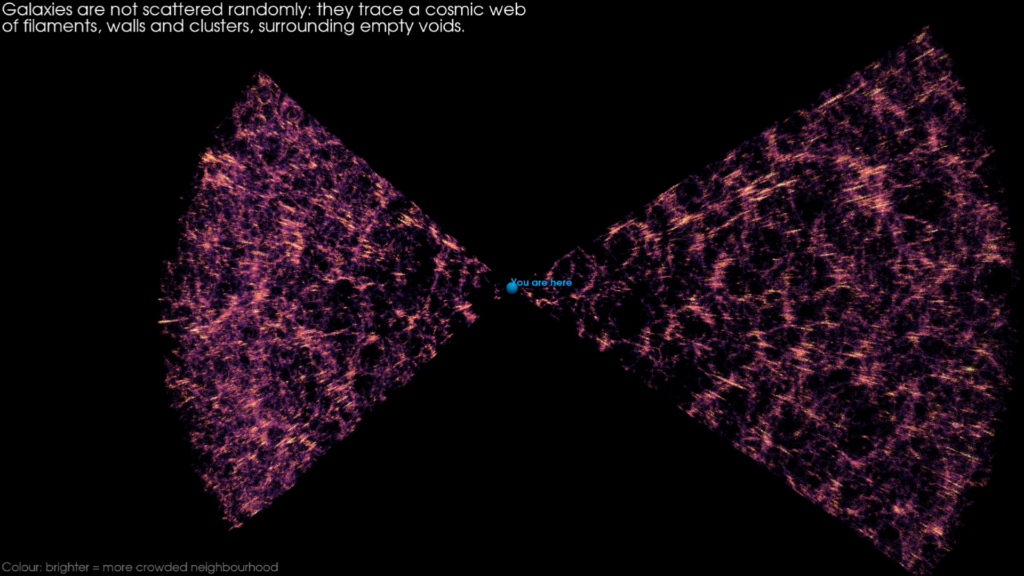
WAVES will survey millions of galaxies, and reveal their location in 3D. Credit: ICRAR
“With 4MOST, we are moving into a scale of data volumes and rates never before seen in astronomy research,” Associate Professor Davies said.
“This requires us to develop completely new and innovative software and computing techniques to process, analyse and deliver the data efficiently.”
Australia’s contribution to 4MOST extends to the advanced instrumentation powering the telescope.
The Australian-European Southern Observatory Positioner (AESOP), developed and built in Australia by the Australian Astronomical Optics team at Macquarie University, uses more than 2,000 individually controlled optical fibres to capture light from thousands of astronomical objects simultaneously.
Together with Australia’s leadership of WAVES from Perth and the 4MOST Hemisphere Survey from Melbourne, these contributions demonstrate the country’s significant role in shaping the scientific direction and technological capability of this major international facility.
4MOST brings together 17 partner institutions and approximately 850 individuals, including around 70 researchers and technical specialists from Australian institutions.
For ICRAR, the collaboration reinforces WA’s position in global astronomy and demonstrates the importance of international partnerships in delivering scientific discoveries.
“4MOST picks up the baton from the Anglo-Australian Telescope (AAT) that led this field for so long,” Professor Driver said.
“It is a different collaborative world now, where forefront science is an internationally cooperative endeavour.
“We look forward to working hand-in-hand with our European partners to keep Australia at the forefront of studying our cosmic origin story.”
MULTIMEDIA
MORE INFORMATION
ICRAR
The International Centre for Radio Astronomy Research (ICRAR) plays a major role in radio astronomy, contributing to scientific discovery, engineering development, education and public engagement. It is a multi-skilled institute of astronomers, engineers, and data specialists working with industry partners throughout Australia, Europe, and the world to support the construction of the SKA telescopes in Australia and South Africa and expand our understanding of the Universe.
It is a joint venture between Curtin University and The University of Western Australia, with support and funding from the State Government of Western Australia.
MEDIA SUPPORT
Annelise Gardner, PR and Media Advisor
The University of Western Australia Media Contact | annelies.gartner@uwa.edu.au | +61 6488 6876 |
INTERVIEWS
Dr Sabine Bellstedt | ICRAR-UWA
Associate Professor Luke Davies | ICRAR-UWA