Recently, the BLINK group (led by the project proposer) reported detection of one low-frequency FRB in archival data from the MWA pulsar survey SMART. It was possible thanks to their extremely efficient imaging processing pipeline using modern Graphical Processing Units (GPUs) in the Setonix supercomputer at Pawsey Supercomputer in Perth. The novel pipeline is very fast and can process single 1h20m SMART observation in about 24 hours, in comparison to weeks or months with traditional pipelines.
The goal of this project is to better characterise the pipeline and understand its efficacy in discovering FRB-like pulses. In order to do this, the student will simulate `artificial` FRB signals and inject (add) them to images generated by BLINK to measure what percentage of the injected FRBs are actually discovered by the pipeline as a function of their flux density (i.e. brightness) and potentially other parameters such as scatter broadening, dispersion measure etc. This work will be extremely valuable and will help to estimate how many FRBs could have been missed in the search and therefore what is the real (efficiency-corrected) FRB rate at frequencies below 200 MHz.
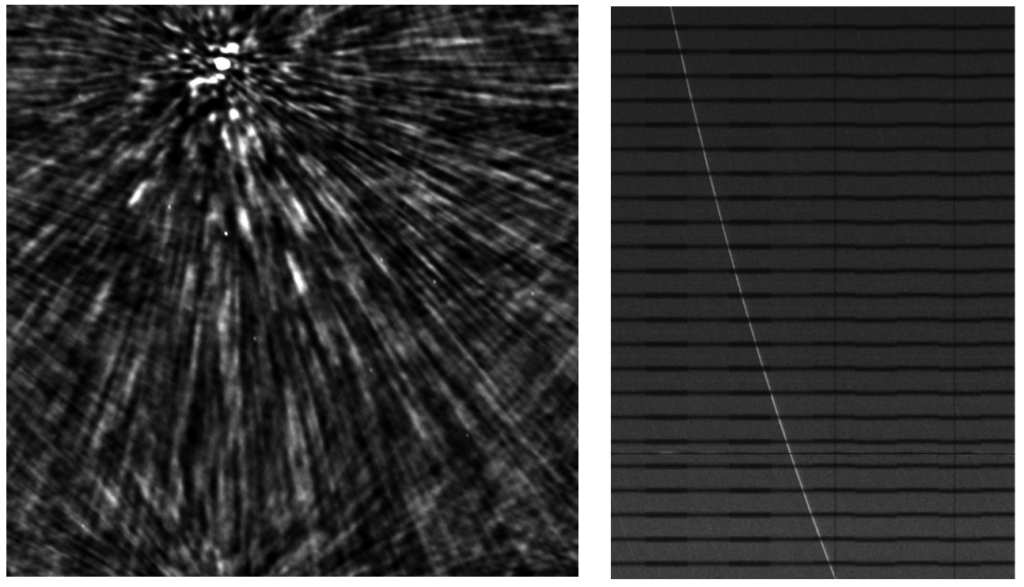
Example image from BLINK pipeline shown the Crab Nebula (left) and dispersed giant pulse from the Crab pulsar (right).
| Student attributes | |
| Academic background | Introductory Physics course |
| Computing skills | Computer programming in at least one language (Python or C/C++). C/C++ would be ideal, but we can get there by starting from Python. |
| Training requirement | None-critical, but some on-line or other C/C++ training would be useful. |
| Project timeline | |
| Week 1 | Inductions and project introduction |
| Week 2 | Initial presentation |
| Week 3 | Getting familiar with the execution and code base of the BLINK pipeline. |
| Week 4 | Getting familiar with the execution and code base of the BLINK pipeline to find place where artficial FRBs can be injected into the data |
| Week 5 | Developing FRB injection code and including into the pipeline. |
| Week 6 | Include and test FRB injection code in the BLINK pipeline. |
| Week 7 | Execution of BLINK pipeline with various parameters to verify efficacy of finding FRBs by BLINK pipeline for various pulse parameters (DM, scattering time, fluence etc). |
| Week 8 | Execution of BLINK pipeline with various parameters to verify efficacy of finding FRBs by BLINK pipeline for various pulse parameters (DM, scattering time, fluence etc). Calculation of measured FRB rates corrected for the measured efficiency of finding FRBs. |
| Week 9 | Final presentation |
| Week 10 | Final report |