Our Galaxy has about 150 globular clusters (GCs), each of which is older than 10 Gyr and has more than 100,000 stars within just 10pc. The origin of these ancient stat clusters has long been one of key problems in the Galaxy formation. Recent observations have discovered stars with extremely high phosphorus abundance (10-100 times the solar abundance) in these clusters. However, it is totally unclear how such “P-rich’’ stars formed in GCs. In this project, students will use supercomputer simulations of dwarf galaxies, which are the building blocks of the Galaxy, and thereby try to investigate how (i) the GCs were formed within dwarf galaxies and (ii) how P-rich stars can form within GCs. Students will particularly investigate the roles of energetic feedback effects from supernovae, novae, and asymptotic giant branch stars in the formation of GCs within dwarf galaxies, because these stars can eject P-rich gas. The expected outcomes of this project include (i) the first construction of GC formation models, (ii) prediction of chemical abundance patters in GCs, and (iii) deeper understanding of the formation processes of GCs within the Galactic building blocks.
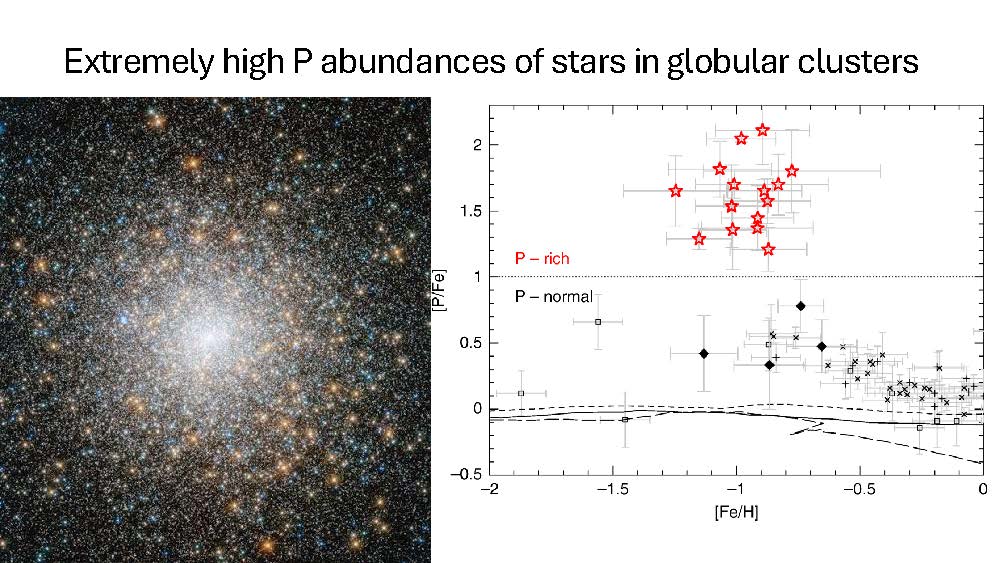
Figure 1: The Galactic globular cluster M15 (Credit: APOD) in the left and the [P/Fe] as a function of [Fe/H] for P-normal and P-rich stars in the Galaxy in the right (Masseron et al. 2020) In this project, students will try to understand the formation of globular clusters using the results of computer simulations.
| Student attributes | |
| Academic background | Basic astronomical knowledge. |
| Computing skills | As long as students can analyze simulation data using any software (e.g., Mathematica) or computer programming (e.g., Python), it should be fine. Very good programming skill is not required. Simulations will be performed on the GPU clusters at ICRAR. If necessary, they will be done on OzSTAR GPU cluster too. But students do not need to be familiar with these simulations. |
| Training requirement | Student will learn how to analyze the data from computer simulations of galaxies using, e.g., Python, Fortran, C, etc. |
| Project timeline | |
| Week 1 | Inductions and project introduction |
| Week 2 | Initial presentation |
| Week 3 | Performance of computer simulations of GC formation |
| Week 4 | Performance of computer simulations of GC formation |
| Week 5 | Analysis of the simulation data to derive the physical properties of GCs (structure parameters of GCs) |
| Week 6 | Analysis of the simulation data to derive the physical properties of GCs (structure parameters of GCs). Creating of new animations on GC formation to understand the physical processes of GC formation |
| Week 7 | Discussion on the origin of the derived physical properties of the simulated GCs |
| Week 8 | If necessary, additional simulations will be run on ozstar (to complete the parameter search). |
| Week 9 | Final presentation |
| Week 10 | Final report |