The largest stars form in cold, dark gas embedded within giant molecular clouds. These clouds are optically thick at most wavelengths and one of the earliest signs that a molecular cloud has switched from quiescent to star forming is the presence of shocks from outflows. These outflows are an integral part of the accretion process and produce shocks as they expand into the surrounding region. Two well-established tracers of shocks in molecular clouds are the presence of emission from thermal emission from SiO and class I methanol masers. The SiO is released from shocked dust grains, while the methanol masers are collisionally pumped in low-velocity shocks. This project will use data from the Australia Telescope Compact Array StarFISH project to undertake the first comprehensive statistical investigation of these two different shock tracers to determine how they relate to the evolution of giant molecular clouds and the star formation that they host.
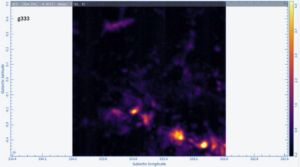
StarFISH image of CS (1-0) Peak intensity in a 1 square degree region l = 333-334 degrees