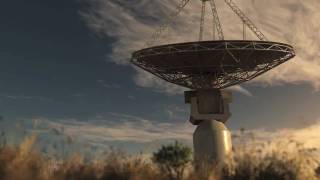
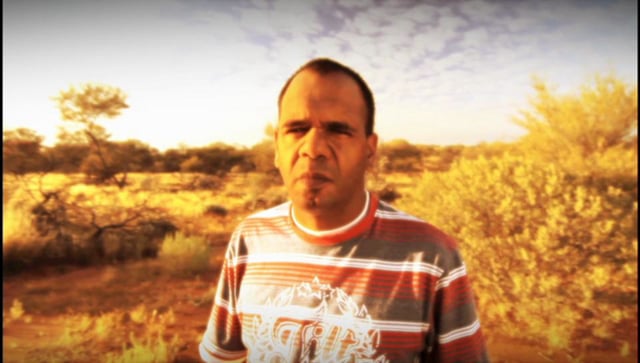
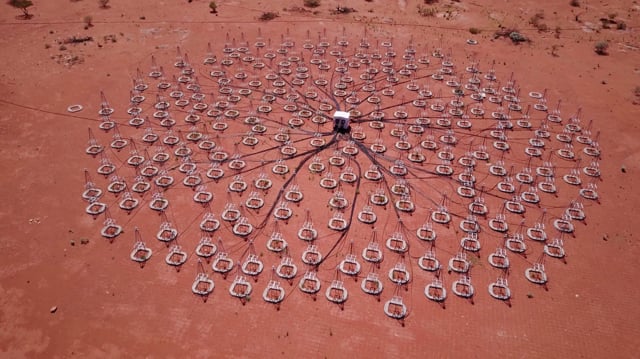
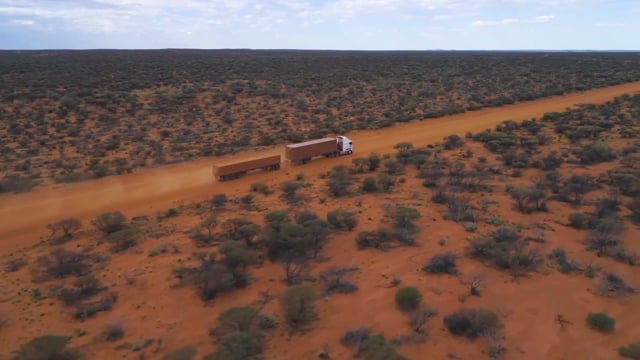
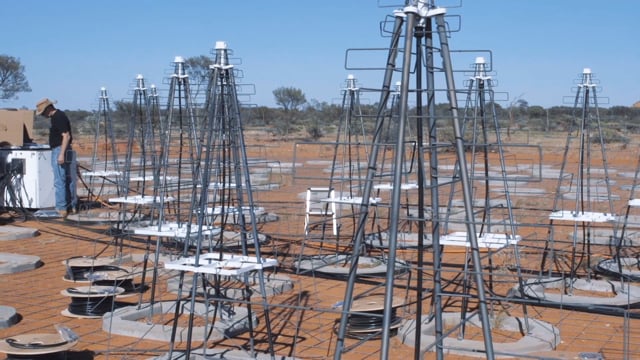
Hear from ICRAR Director Professor Peter Quinn and SKA Director Dr Brian Boyle and other leaders in Australian astronomy about why they are excited about the SKA.
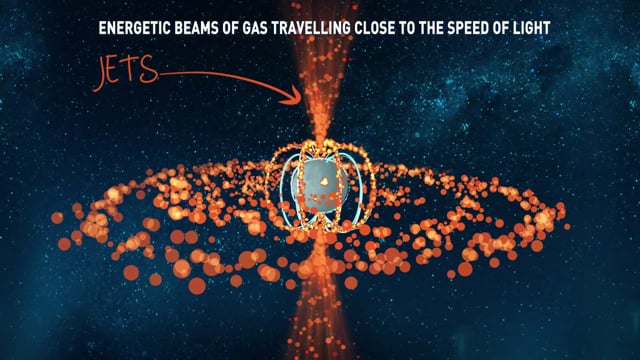
What will the SKA reveal about the Universe? Hear about the key science planned for the SKA. Credit: SKA Program Development Office and Swinburne Astronomy Productions.
This Trailer has been produced by Scitech, in Perth Western Australia and Questacon, the National Science Centre in Canberra with funding from the Australian Government, through the Department of Innovation, Industry, Science and Research.
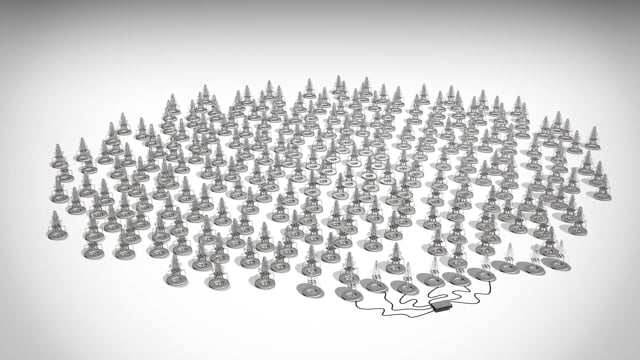
Credit: Swinburne Astronomy Productions, design data provided by CSIRO
ASKAP is led by the Commonwealth Science and Industrial Research Organisation (CSIRO) in collaboration with leading scientists and engineers in the Netherlands, Canada, United Kingdom and Germany, as well as colleagues from a number of Australian universities.
This piece is the first in a series of videos created by SPICE.
SPICE is a secondary teacher's enrichment program providing science teachers with funded access to professional development, supported by exciting new curriculum resources and opportunities for interaction with leading scientists, science educators and multimedia developers.
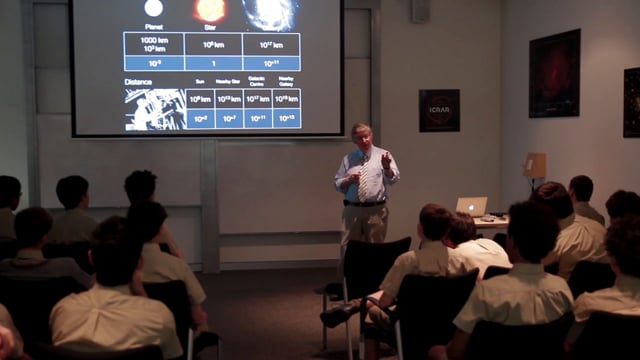
Professor Peter Quinn visited the RiAus in Adelaide and gave an evening presentation and a teacher professional development session on radio astronomy and the SKA. There are also accompanying teacher notes available from the RiAus On Demand page.
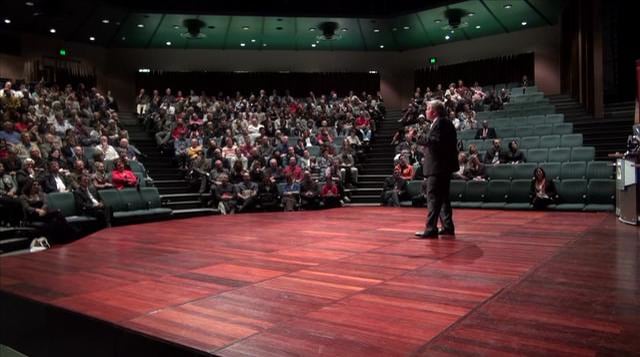
Evening presentation
Audience questions
Teacher professional development
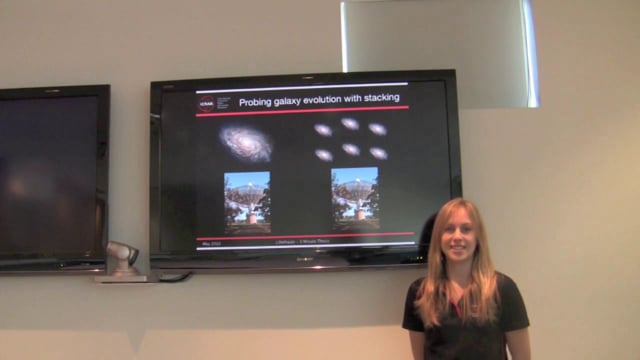
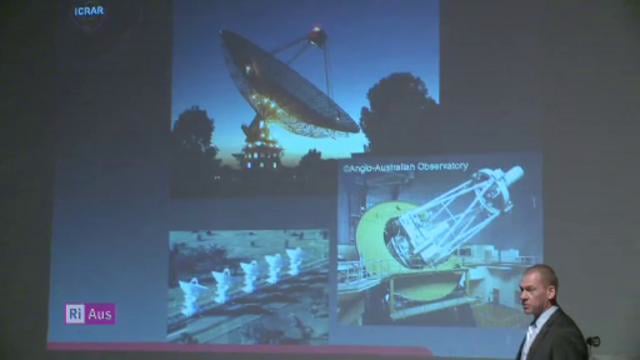
Professor Steven Tingay visited Bendigo in Victoria as part of RiAus's Free Range Science. He gave a presentation on the SKA and Australia's work towards it and the RiAus were kind enough to share the presentation online for all of us.
Part 1, Introduction
Part 2, SKA science
Part 3, SKA logistics
Audience Questions
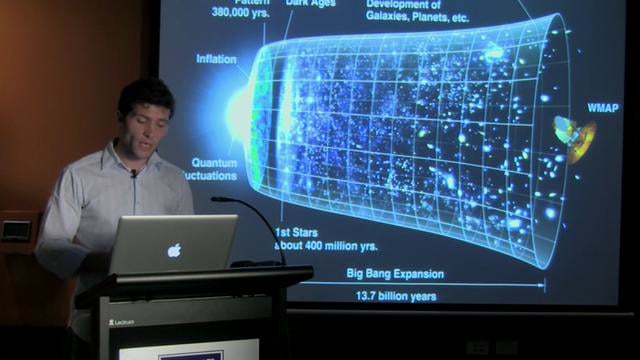
What is Cosmology? What does the Universe look like? What will happen to the Universe in the future? What do we know about the Universe and how do we know it? An introduction to Cosmology presented by Dr Alan Duffy.
Download the pdf presentation Dr Duffy is presenting.
Also available as an accessible rtf.
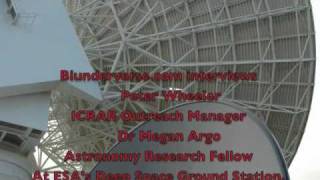
During National Science Week ICRAR Education and Outreach travelled to the ESA's New Norcia Tracking Station with radio and optical telescopes for a public event. ICRAR's Peter Wheeler and Dr Megan Argo were interviewed on location by Blunderverse. Watch the interviews.
In mid-May ICRAR researchers joined Questacon (the National Science and Technology Centre in Canberra) on their SKA video conferences for school students around Australia. The video conferences were part of the Discover SKA project to increase anticipation and excitement for the SKA. Watch two of the video conferences.
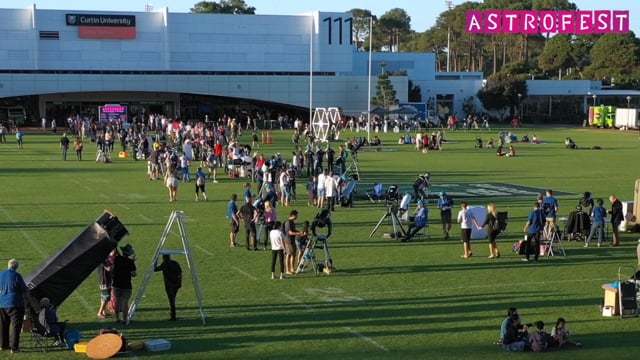
Over 3,000 people came to Curtin University for Astrofest 2011. Thanks to Richard Johnson from Rostrata Primary School for this video of the event. For more details see the Astrofest event page.
theSkyNet was launched on September 13th, 2011. Donate your spare computing power to radio astronomy so you can help discover something amazing! Learn more about theSkyNet distributed computing project.
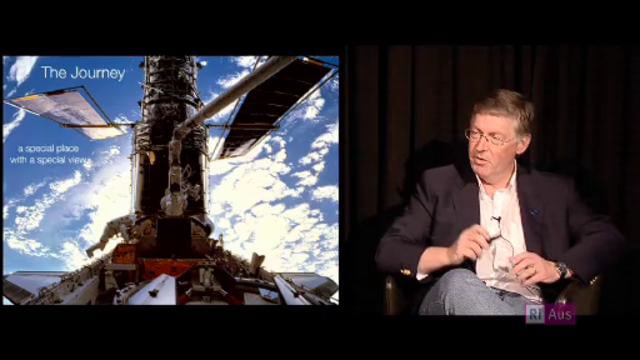
As part of an ICRAR lecture series Professor Gerhardt Meurer talks about the Hubble Space Telescope and what the future holds. For more details see the public talk page.
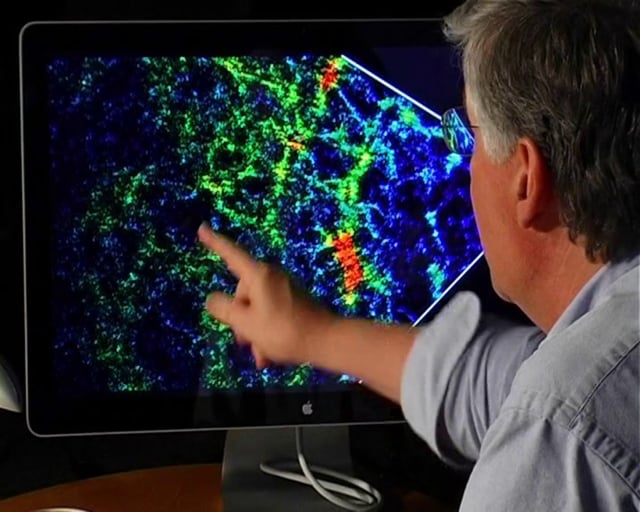
This is a fly through of a cosmological simulation that has been converted into what a radio telescope such as ASKAP will see.
We start the movie at low frequency, which means a large distance away (redshifting by the Universes expansion shifts the ~1.4 GHz neutral hydrogen line to lower frequencies). The Declination (y-axis) is the 'up-down' axis on the sky and Right Ascension (x-axis) is the 'left-right' measure on the horizon. The field of view in this telescope is 10 square degrees.
The red dots are galaxies and the broad green distributions are of the cosmic web that lies between the galaxies and clusters of galaxies.
The top left panel is the original particle distribution from the simulation, with red colours indicating a strong signal, and blue a weaker signal.
The top right panel is after smoothing the particles in frequency due to thermal broadening. As gas has a temperature individual atoms will move in random directions which will emit HI at different blue/red-shifted frequencies (giving an overall broadening of the signal in frequency).
The bottom right panel takes these particles and smoothes them in space using the smoothing kernel from the simulation, corrected for the projection map of this radio observation.
The bottom left panel is the final step in creating a mock observation by smoothing the datacube with the actual beam of the telescope (seen as a small black circle in the bottom left). This represents the actual observation that a telescope would see.
Credit: Dr Alan Duffy, ICRAR and the OWLS Team
Starting from 25 h^-1 Mpc across we see the column density of Neutral Hydrogen - HI (as detectable by radio telescopes such as ASKAP).
The broad filaments of low density HI (in purple) is the Cosmic Web and traces the underlying Dark Matter distribution. At the nodes of theweb are cluster of galaxies, one of which we zoom in on.
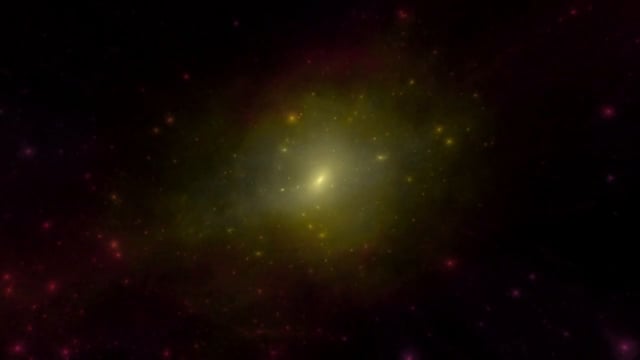
The final galaxy we can see is of a galaxy about the size of our Milky Way (10^12 Msol) but when the Universe was only a few billion years old, making it truly a monster galaxy at this point in time. The blobs of cold material (green) are falling into the central disk, which is of very high density (seen in red). Galaxy formation at this early time was an active and dynamically complex process.
The simulation zooms out again showing that this galaxy is but a tiny part of the much larger picture.
Credit: Dr Alan Duffy, ICRAR
View the version without labels here.